
Everest region trekking guide: the Khumbu in detail
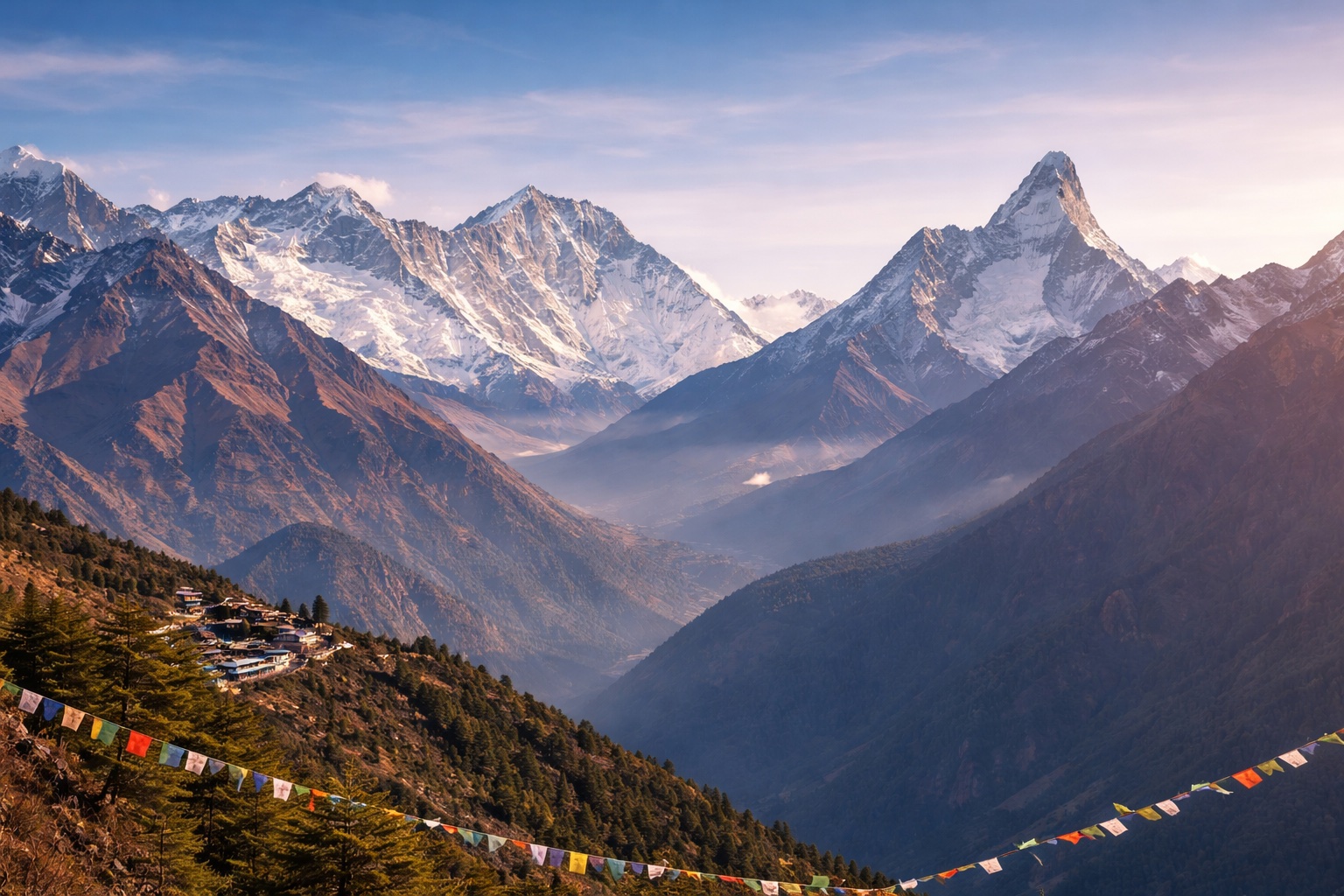
Few places on Earth carry the same sense of adventure as the Everest region. Known locally as the Khumbu, this high valley system in north-eastern Nepal is home to Mount Everest (8,849 m), the highest mountain in the world, as well as Lhotse, Nuptse, Cho Oyu, Makalu on its eastern edge and the elegant Ama Dablam. It is also the homeland of the Sherpa people, whose monasteries, prayer flags and stone villages give the region a character as strong as its scenery.
This guide covers everything you need to know about Everest region trekking: the main routes, a typical Everest Base Camp itinerary, the Lukla flight, the best seasons, altitude and acclimatisation, permits, accommodation and costs on the trail, and how to prepare. It is written by the Himalayan Hiking team in Kathmandu, who organise Everest treks every spring and autumn.
Why trek in the Everest region?
The Khumbu offers something no other trekking area can: the chance to walk to the foot of the world's highest mountain. But the appeal goes far beyond Everest itself. Within a few days of leaving Lukla you are surrounded by peaks over 6,000, 7,000 and 8,000 metres, and every bend of the trail reveals a new view. The walking is varied, from pine and rhododendron forest in the lower valley to high alpine pastures, glacial moraine and the vast icefalls around base camp.
The region is also one of the best organised in Nepal. Lodges along the main trails are comfortable, food is plentiful and varied, and the route is well marked. Big scenery, strong Sherpa culture and reliable lodges make the Everest region a good choice for fit, well-prepared first-timers and for experienced hikers looking for high passes and remote valleys.
Sagarmatha National Park and Sherpa culture
Most Everest treks take place inside Sagarmatha National Park, established in 1976 and listed as a UNESCO World Heritage Site in 1979. Sagarmatha is the Nepali name for Everest; in Tibetan and Sherpa it is Chomolungma. The park protects high mountain ecosystems that are home to Himalayan tahr, musk deer, the Danphe (Himalayan monal, Nepal's national bird) and, very rarely seen, the snow leopard.
The Sherpa people migrated to the Khumbu from Tibet several centuries ago, and Tibetan Buddhism shapes daily life here. You will walk past mani stones carved with the mantra Om Mani Padme Hum, spin prayer wheels and pass chortens and gompas (monasteries). Always walk clockwise around religious monuments, keeping them on your right. Tengboche Monastery, set on a ridge with Ama Dablam and Everest behind it, is the spiritual heart of the region and hosts the colourful Mani Rimdu festival, usually in October or November. Older monasteries at Pangboche, Thame and Khumjung are also worth visiting.
Namche Bazaar, the main Sherpa town, sits in a natural amphitheatre at 3,440 m. It has lodges, bakeries, gear shops, a museum about Sherpa culture and mountaineering, and a weekly market where traders bring goods up from the lowlands. It is the natural place for your first acclimatisation day.
The best Everest region treks
Everest Base Camp trek
The Everest Base Camp trek is the classic route and one of the most famous treks in the world. It follows the Dudh Koshi valley from Lukla to Namche Bazaar, then climbs past Tengboche, Dingboche and Lobuche to Gorak Shep, the last settlement before base camp. From here you visit Everest Base Camp (5,364 m) at the foot of the Khumbu Icefall and climb Kala Patthar (5,545 m), a rocky viewpoint with the finest close-up view of Everest's summit. The round trip from Lukla takes around 12–14 days.
Gokyo Lakes trek
The Gokyo Lakes trek leaves the main trail above Namche and heads up the Dudh Koshi valley to a chain of turquoise glacial lakes beside the Ngozumpa Glacier, the longest glacier in Nepal. The best day is the climb to Gokyo Ri (5,357 m), where you can see four 8,000-metre peaks at once: Everest, Lhotse, Makalu and Cho Oyu. Many trekkers consider the view from Gokyo Ri better than Kala Patthar. The trek takes around 11–13 days from Lukla and is quieter than the base camp route.
Gokyo and Everest Base Camp via Cho La
For a longer loop, you can combine Gokyo and Everest Base Camp by crossing the Cho La pass (5,420 m). This involves a steep climb and a short section on a glacier, which can be icy, so it is suited to fit trekkers with some experience. The combined route takes about 15–17 days.
Everest Three Passes trek
The Everest Three Passes trek is the ultimate Khumbu challenge. It crosses the Kongma La (5,535 m), Cho La (5,420 m) and Renjo La (5,360 m) and visits Everest Base Camp, Kala Patthar and Gokyo along the way, forming a complete circuit of the region. It takes around 17–20 days and requires excellent fitness and previous experience at high altitude.
Everest View and short treks
If you have limited time or prefer to stay lower, a short Everest View trek to Namche Bazaar, Khumjung and Tengboche gives superb views of Everest, Lhotse and Ama Dablam without going above about 3,900 m. It takes about 7–9 days from Kathmandu and suits families and those new to trekking.
Trekking peaks
For climbers, the Khumbu is also home to popular trekking peaks such as Island Peak (Imja Tse, 6,165 m) and Lobuche East. These require mountaineering equipment and skills, a climbing permit and a climbing guide, and are usually combined with the Everest Base Camp trek for acclimatisation.
Everest Base Camp trek: a typical itinerary
Every itinerary is slightly different, but a well-paced Everest Base Camp trek follows this pattern. Altitudes are approximate.
| Day | Route | Overnight altitude |
|---|---|---|
| 1 | Fly Kathmandu (or Ramechhap) to Lukla, trek to Phakding | 2,610 m |
| 2 | Phakding to Namche Bazaar, entering Sagarmatha National Park | 3,440 m |
| 3 | Acclimatisation day in Namche; hike to the Everest View Hotel or Khumjung | 3,440 m |
| 4 | Namche to Tengboche, visit the monastery | 3,860 m |
| 5 | Tengboche to Dingboche via Pangboche | 4,410 m |
| 6 | Acclimatisation day in Dingboche; hike to Nangkartshang viewpoint | 4,410 m |
| 7 | Dingboche to Lobuche, past the climbers' memorials at Thukla | 4,940 m |
| 8 | Lobuche to Gorak Shep, afternoon visit to Everest Base Camp | 5,164 m |
| 9 | Sunrise climb of Kala Patthar (5,545 m), descend to Pheriche | 4,370 m |
| 10 | Pheriche to Namche Bazaar | 3,440 m |
| 11 | Namche to Lukla | 2,860 m |
| 12 | Fly Lukla to Kathmandu | — |
With an arrival day and a sightseeing day in Kathmandu at the start, and a spare day at the end for possible flight delays, most Everest Base Camp trips last 14–16 days in total. Our trip page shows the exact itinerary, inclusions and departure dates.
The Lukla flight and getting to the Khumbu
Almost all Everest treks begin with the short, scenic flight to Tenzing-Hillary Airport in Lukla (2,860 m), a mountain airstrip with a short, sloping runway. The flight takes around 30–40 minutes from Kathmandu and offers views of the Himalaya on a clear morning. During the busiest months, flights to Lukla are often operated from Manthali airport in Ramechhap, a drive of about four to five hours from Kathmandu, to reduce congestion at Kathmandu airport. We confirm the departure airport before your trip and arrange the transfer.
Lukla flights depend on clear weather at both ends, and delays or cancellations are common, especially in the afternoon and during the shoulder seasons. For this reason we always recommend keeping one or two spare days at the end of your trip. If flights are cancelled for several days, helicopter charters are sometimes available at an extra cost, which can be shared between passengers.
It is also possible to walk in to the Khumbu from the road head at Jiri or Salleri (Phaplu), following the old expedition route through the lower Solukhumbu. This adds around five to seven days but helps with acclimatisation and passes through quiet villages rarely seen by trekkers.
Best time to trek in the Everest region
Autumn: late September to November
Autumn is the most popular season for Everest treks. After the monsoon the air is clear and views are at their sharpest. Days are generally sunny and mild in the valleys, while nights at Lobuche and Gorak Shep drop well below freezing. October is the busiest month; November is colder but often very clear and a little quieter.
Spring: March to May
Spring is the second main season and a special time to visit Everest Base Camp, as climbing expeditions set up their tents for summit attempts in May. Rhododendrons bloom in the lower valleys in March and April, and temperatures are warmer than in autumn. Clouds tend to build in the afternoons, especially later in the season.
Winter: December to February
Winter brings the coldest temperatures, with nights well below −10°C at the highest lodges, and occasional snowfall. Skies are often clear, though, and the trails are very quiet. Winter treks are possible with warm equipment and flexible plans; some high lodges close during the coldest weeks. Lower Everest View treks are an excellent winter option.
Monsoon: June to early September
The monsoon brings cloud, rain in the lower valley and frequent Lukla flight cancellations. Higher up, above Namche, rainfall is lighter and it is possible to trek, but views are often hidden. It is the quietest season on the trails and the wildflowers are at their best.
How difficult is Everest region trekking?
The Everest Base Camp trek is graded strenuous. It is non-technical, following well-used trails without climbing sections, but it combines long walking days of 5–7 hours with significant altitude. The first days include steep climbs, notably the long ascent to Namche Bazaar, and there are many steps and rocky sections. The final days above 4,900 m are slow going as the air becomes thinner.
You do not need previous experience at altitude, but you should be in good health and comfortable walking several days in a row on hilly terrain. The Gokyo trek is of similar difficulty; the Three Passes trek and routes crossing Cho La are graded challenging because of the steep passes, glacier crossings and many days above 5,000 m.
Altitude and acclimatisation in the Khumbu
Altitude is the biggest challenge on any Everest trek. Lukla is already at 2,860 m, and you gain height quickly. Acute mountain sickness (AMS) can affect anyone regardless of age or fitness, so a gradual itinerary is essential. Our Everest treks include at least two acclimatisation days, usually at Namche Bazaar and Dingboche, and follow the principle of climbing higher during the day and sleeping lower.
Common early symptoms of AMS include headache, nausea, dizziness, poor appetite and difficulty sleeping. Mild symptoms often improve with rest and hydration, but worsening symptoms mean you must stop ascending and, if needed, descend. Our guides carry a first-aid kit and a pulse oximeter, check trekkers every day and are trained to make safe decisions. There is a Himalayan Rescue Association health post in Pheriche during the main seasons, and helicopter evacuation is available when needed, which is why insurance covering evacuation to at least 6,000 m is essential.
The dry, cold air at altitude also causes the well-known "Khumbu cough". Covering your mouth and nose with a buff while walking, drinking plenty of warm fluids and sucking throat lozenges all help.
Permits for the Everest region
Trekkers in the Everest region need two permits:
- Sagarmatha National Park entry permit, checked at the park entrance at Monjo.
- Khumbu Pasang Lhamu Rural Municipality entry permit, issued at Lukla.
Treks that approach from Jiri or Salleri may also need a Gaurishankar Conservation Area permit. Climbing permits are required for trekking peaks such as Island Peak. Rules and fees change periodically, so we confirm the current requirements when you book. Himalayan Hiking arranges every permit as part of your trek, so you only need your passport and a few passport photos.
Teahouses, food and facilities on the Everest trail
The Everest region has some of the best trekking lodges in Nepal. In Lukla, Phakding and Namche Bazaar many lodges offer rooms with attached bathrooms, hot showers and comfortable beds. Higher up, rooms are simpler twin rooms with shared toilets, and the dining room with its central stove becomes the social centre of the lodge in the evening.
Menus are extensive. Dal bhat remains the trekker's staple, with free refills, but you will also find Sherpa stew, noodle soup, fried rice, potatoes, pasta, pizza, momos, pancakes, porridge and eggs, as well as bakery cakes in Namche. Prices rise as you climb because everything is carried up by porters, yaks and zopkyo (yak-cattle crossbreeds). Most trekkers eat vegetarian food above Namche, as meat is carried up without refrigeration.
Charging batteries and hot showers are usually paid extras higher up. Wi-Fi is widely available through local networks sold on prepaid cards, and mobile data works in many villages, although signals weaken near base camp. There are ATMs in Lukla and Namche, but they are not always reliable, so bring enough Nepali rupees from Kathmandu for extras.
Drinking water is available from lodges, either boiled or filtered, and refill stations operate in several villages. Using a refillable bottle and purification tablets or a filter helps reduce plastic waste in the park, which is a serious problem at high altitude.
What to pack for an Everest trek
Because temperatures range from warm days in the lower valley to nights well below freezing at Gorak Shep, layering is essential. In addition to a standard trekking kit, bring:
- A warm down jacket rated for sub-zero temperatures, plus insulated gloves and a warm hat.
- A four-season sleeping bag, or a three-season bag with a liner; we can arrange rental in Kathmandu.
- Thermal base layers for the higher nights.
- Good-quality sunglasses with UV protection and high-factor sunscreen, as the sun and glare at altitude are intense.
- A buff or face covering for dust and cold air.
- Microspikes for icy sections in winter or on the Cho La pass.
- Trekking poles for the long descents from Kala Patthar and Namche.
Domestic flights to Lukla have strict baggage limits, typically around 15 kg in total including hand luggage, so pack carefully. You can leave extra luggage safely at your hotel in Kathmandu.
Training for the Everest Base Camp trek
The better prepared you are, the more you will enjoy the Khumbu. Start training at least two to three months before your trek. Focus on long walks with elevation gain, ideally on hills or mountains, carrying a daypack of five to seven kilograms. Build up to walks of five to six hours and, if possible, do two or three long days back to back to get used to walking on tired legs.
During the week, add cardiovascular training such as running, cycling, swimming or stair climbing, three or four times a week for 30–60 minutes. Leg strength matters on the long descents, so include squats, lunges, step-ups and calf raises. Core and back exercises help you carry a daypack comfortably. If you live somewhere flat, a stair machine or tall building with many flights of stairs is excellent preparation.
No amount of training at sea level fully prepares you for altitude, which is why a gradual itinerary matters so much. Good fitness, however, means you recover faster each evening, sleep better and have more energy to enjoy the views.
What does an Everest trek cost?
The cost of an Everest region trek depends on the route, the number of days, the size of your group and the level of accommodation. A guided package usually includes airport transfers, hotels in Kathmandu, return Lukla flights, permits, teahouse accommodation, a licensed guide and porters. Some packages also include all meals on the trek; others include breakfast only. Check what is included when you compare prices.
On top of the package, budget for your international flights, Nepal visa, travel insurance, equipment, drinks and snacks on the trail, hot showers, battery charging and Wi-Fi, and tips for your guide and porters. Tipping at the end of the trek is customary in Nepal and an important part of trekking staff income. Our trip pages list the exact price and inclusions for each Everest trek, and we are happy to explain every cost before you book.
Helicopter options
For trekkers short on time, it is possible to trek to Everest Base Camp and return to Lukla or Kathmandu by helicopter from Gorak Shep or Pheriche. This saves around three days of walking, and you fly out past the peaks you've just walked under. Scenic helicopter tours to Kala Patthar with a short landing are also available for those who cannot trek. Helicopter prices depend on the number of passengers and the season; ask us for a quote.
Responsible trekking in the Khumbu
The Khumbu is a fragile high-mountain environment and a living cultural landscape. Help protect it by carrying out your non-biodegradable waste, especially batteries and plastic packaging; refilling water instead of buying plastic bottles; respecting monasteries and religious sites; asking permission before photographing people; and giving way to yaks and porters on the trail, always stepping to the uphill side. Choosing a local company that pays guides and porters fairly and follows good porter welfare practices keeps the benefits of tourism in Nepal's mountain communities.
Book your Everest region trek with Himalayan Hiking
Himalayan Hiking is based in Kathmandu. We plan our Everest itineraries with realistic walking days and proper acclimatisation, and we arrange your Lukla flights, national park and municipality permits, lodges, licensed English-speaking guide and porters. You can join a small-group fixed departure in spring or autumn or book a private Everest trek on your own dates, with the route adjusted to include Gokyo, the passes or a helicopter return.
Browse our Everest region treks above, or contact us with your dates and experience. Our team will recommend the right route and send a detailed itinerary and quote.