
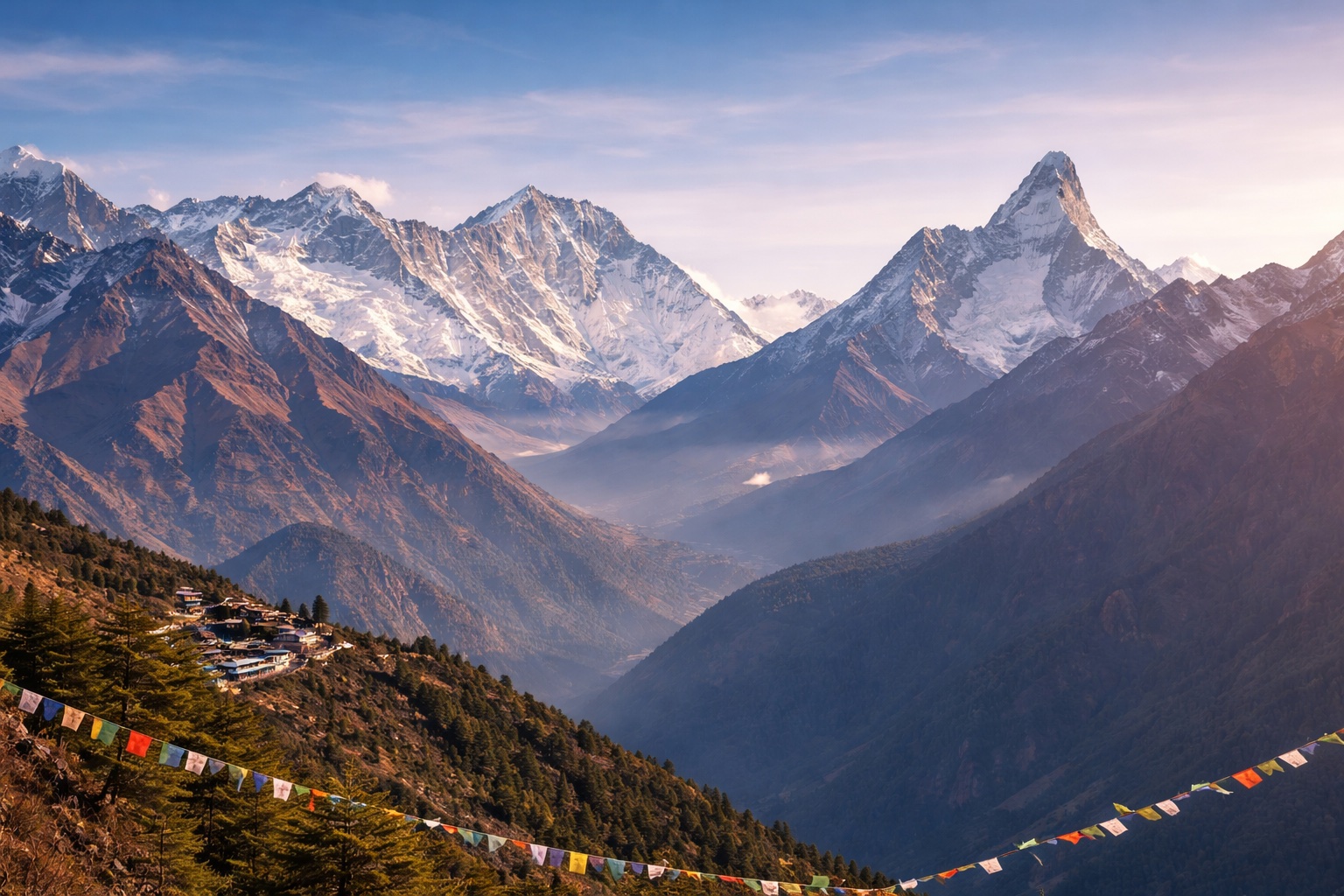
Helicopter tours in Nepal: a complete guide
Nepal is home to eight of the world's fourteen highest mountains, but many of them lie days or weeks of walking from the nearest road. A helicopter tour brings these mountains within reach in a single morning. Flying low along valleys and ridges, you pass terraced villages, monasteries, glaciers and icefalls before landing at a viewpoint surrounded by some of the highest peaks on Earth. It's one of the most popular things to do in Nepal, and almost anyone can do it, whatever their age or fitness.
This guide explains how helicopter tours work in Nepal, describes the most popular flights, including the Everest helicopter tour and the Annapurna Base Camp helicopter tour, and covers shared versus private flights, weather, altitude, safety, what to wear and how to combine a helicopter tour with a trek. It is written by the Himalayan Hiking team in Kathmandu.
Why take a helicopter tour?
There are many reasons to choose a helicopter tour. If you are in Nepal for only a few days, it is the only way to see Everest up close. If health, age or mobility make trekking at altitude difficult, a helicopter lets you experience the high Himalaya without the physical challenge. Families use helicopter tours to share the mountains with grandparents and young children, and couples choose them for anniversaries, honeymoons and proposals. For trekkers, a helicopter can shorten the return journey after reaching base camp or avoid delays when Lukla flights are cancelled.
From a helicopter you see the mountains from a completely different angle. From the air, you appreciate the scale of the Himalaya, the depth of the valleys and the size of the glaciers in a way that is impossible on foot.
Everest helicopter tour
The Everest helicopter tour is the most popular helicopter flight in Nepal. It usually departs from Kathmandu at around sunrise, when the weather is most stable, and follows this pattern:
- Kathmandu to Lukla (about 45–50 minutes): fly east over the hills with the Himalaya on the left, then land at Lukla to refuel and, if needed, adjust the passenger load for high altitude.
- Lukla to Kala Patthar or Everest Base Camp: fly up the Dudh Koshi and Khumbu valleys, past Namche Bazaar, Tengboche Monastery and Ama Dablam, to land near Kala Patthar (5,545 m) or, when conditions allow, close to Everest Base Camp. You get out for a short stop to take photographs of Everest, Nuptse, Lhotse, Pumori and the Khumbu Glacier.
- Breakfast with a view: descend to a hotel on the ridge above Namche Bazaar, at around 3,800–3,900 m, for breakfast on a terrace facing Everest and Ama Dablam.
- Return to Kathmandu via Lukla, arriving back in the late morning or around midday.
The whole tour lasts about four to five hours. The exact landing points depend on the weather, wind, snow conditions and the pilot's judgement on the day.
Annapurna Base Camp helicopter tour
From Pokhara, the Annapurna Base Camp helicopter tour flies up the Modi Khola valley past Machhapuchhre (Fishtail) into the Annapurna Sanctuary, a natural amphitheatre of peaks including Annapurna I, Annapurna South, Hiunchuli and Gangapurna. The helicopter lands at Annapurna Base Camp (4,130 m) for a short stop surrounded by ice walls and glaciers. The round trip from Pokhara takes around one and a half to two hours, making it easy to combine with a stay in Pokhara.
Other helicopter tours in Nepal
Langtang helicopter tour
The Langtang helicopter tour flies north from Kathmandu to the Langtang valley, landing near Kyanjin Gompa or a higher viewpoint beneath Langtang Lirung. It is the shortest high-mountain helicopter flight from Kathmandu and offers close views of glaciers and Tibetan-style villages.
Gosainkunda helicopter tour
The holy lakes of Gosainkunda, at about 4,380 m, are an important pilgrimage site for Hindus and Buddhists. A Gosainkunda helicopter tour allows pilgrims to visit the lakes in a single day, especially around the Janai Purnima festival, without the steep trek.
Muktinath helicopter tour
The Muktinath helicopter tour is popular with Hindu and Buddhist pilgrims. It flies from Kathmandu or Pokhara through the Kali Gandaki gorge, between Dhaulagiri and the Annapurnas, to Muktinath Temple in Mustang, allowing time for darshan and prayers before returning the same day.
Helicopter charters and trek returns
Helicopters can also be chartered for custom flights: a return from Everest Base Camp or Gorak Shep after trekking, a flight out of remote regions such as Upper Mustang or Makalu, or a scenic tour of your own design. For trekkers, a helicopter return from base camp saves several days of walking and ends the trek with a flight down the valley.
Comparing Nepal helicopter tours
| Tour | From | Duration | Landing altitude | Best for |
|---|---|---|---|---|
| Everest | Kathmandu | 4–5 hours | Up to about 5,500 m | Seeing Everest up close |
| Annapurna Base Camp | Pokhara | 1.5–2 hours | 4,130 m | Annapurna Sanctuary |
| Langtang | Kathmandu | 2.5–3.5 hours | About 3,900–4,500 m | Shortest flight from Kathmandu |
| Gosainkunda | Kathmandu | 2.5–3.5 hours | About 4,380 m | Pilgrimage to sacred lakes |
| Muktinath | Kathmandu or Pokhara | 3–5 hours | About 3,800 m | Pilgrimage to Muktinath Temple |
Shared or private helicopter tours
You can book a helicopter tour in two ways:
- Shared tour: you buy seats on a helicopter with other travellers. It is the more affordable option, but departure depends on enough passengers booking for the same day, and seating is shared.
- Private charter: you hire the whole helicopter for your group, choose your departure date and, within safety limits, have more flexibility over timing and stops. It suits families, groups of friends and special occasions.
The number of passengers on a helicopter is limited by weight, especially for high-altitude landings, where thinner air reduces the helicopter's lifting power. Most tours carry four to five passengers in total, and on high landings the load may be split between two shuttles or reduced at Lukla. Each passenger's weight is recorded before the flight.
Best time for a helicopter tour
Helicopter tours operate throughout the year when weather allows, but some seasons are more reliable:
- October–November: the best season, with the clearest skies and sharpest mountain views.
- December–February: often very clear but cold; high landings may be limited by snow or wind.
- March–May: good flying conditions, especially in the early morning; afternoon clouds are more common.
- June–September: the monsoon brings cloud and rain, and flights are frequently delayed or cancelled. Flights are still possible on clear mornings.
Mountain weather changes quickly, so all flights depart early in the morning. We recommend booking your helicopter tour at the start of your time in Nepal, so that it can be rescheduled if weather prevents flying on the first day.
Altitude and health on a helicopter tour
A helicopter can take you from Kathmandu at around 1,400 m to more than 5,000 m in about an hour, with no time for acclimatisation. For this reason, high-altitude landings are kept short, usually five to ten minutes. Most healthy passengers experience only mild effects such as slight breathlessness or light-headedness. Move slowly, avoid exertion and tell the pilot or crew if you feel unwell. The longer breakfast stop takes place at a lower altitude.
Anyone with heart or lung conditions, high blood pressure or other significant health issues should consult a doctor before booking. Pregnant travellers are generally advised not to fly to high altitude. Children can usually join helicopter tours, but parents should discuss the altitude with their doctor, especially for very young children.
Safety
We work only with established helicopter operators licensed by Nepal's Civil Aviation Authority, with experienced mountain pilots and well-maintained aircraft. Pilots make the final decision on weather, landing sites and passenger loads, and flights are postponed or rerouted whenever conditions are not safe. Before departure, you receive a safety briefing, and all passengers wear seat belts and headsets. Your travel insurance should cover helicopter flights and travel to the altitudes of your landing points.
What to wear and bring
Even on a sunny day, it is cold and windy at 5,000 metres. Bring:
- A warm down jacket, hat and gloves.
- Comfortable shoes with good grip, as landing sites can be rocky or snowy.
- Sunglasses and sunscreen for the strong high-altitude sun and glare.
- A camera or phone with a charged battery; cold drains batteries quickly.
- Your passport, which may be checked at Lukla or national park posts.
- A small bag only; luggage space is very limited.
Photography tips
For the best photographs, ask to sit on the side facing the mountains on the way up; on the Everest flight this is usually the left side from Kathmandu to Lukla. Turn off your camera's flash and hold your lens close to the window, but without touching it, to reduce reflections. At landing sites, you have limited time, so plan your shots: a wide view of the peaks, a portrait with Everest behind you and a few moments simply to enjoy the view without a camera.
Helicopter tours for pilgrims
Helicopters have made some of Nepal's most sacred high-altitude sites accessible to elderly pilgrims and those with limited time. Muktinath and Gosainkunda helicopter tours are especially popular with pilgrims from India and Nepal, and Kailash Mansarovar pilgrims sometimes use helicopters on the Nepal side of the route. During major festivals demand is high, so book well in advance. We can arrange puja, priests and vegetarian meals as part of a pilgrimage helicopter tour.
Combining a helicopter tour with your trip
A helicopter tour fits easily into any Nepal itinerary. Travellers on a cultural tour often add the Everest helicopter tour on their first or second morning in Kathmandu, or the Annapurna Base Camp tour during their stay in Pokhara. Trekkers use helicopters to return from Everest Base Camp or Gorak Shep, shortening their trip by several days, or to fly into the heart of the mountains and trek out. We can plan the flight, transfers and hotel arrangements so that everything fits together smoothly.
What does a helicopter tour cost?
The price of a helicopter tour depends on the destination, the number of passengers, whether it is shared or private, the season and fuel prices. Shared seats are priced per person, while a private charter is priced per helicopter. Prices usually include hotel transfers in Kathmandu or Pokhara, the flight, landing fees and, for the Everest tour, breakfast. National park fees may be charged separately. Contact us for a current quote for your date and group size.
What you will see on the Everest helicopter tour
The Everest flight is packed with famous sights. After leaving Kathmandu, the helicopter follows the Himalaya east, with views of Langtang, Dorje Lakpa and Gauri Shankar on clear mornings. Approaching Lukla, you see the steep terraces and forests of the Dudh Koshi valley. Beyond Lukla, you fly past Namche Bazaar in its horseshoe-shaped bowl, Tengboche Monastery on its forested ridge, and the elegant peak of Ama Dablam. Higher up, the valley opens into the moraines and glacial lakes of the upper Khumbu, with Lhotse, Nuptse, Pumori and finally Everest rising ahead. At the landing site, the Khumbu Glacier and Icefall stretch below the summit of the world's highest mountain.
Everest mountain flight or helicopter tour?
There are two ways to see Everest from the air without trekking. The Everest mountain flight uses a small plane that flies along the Himalaya from Kathmandu and back in about an hour, without landing. It is affordable, and every passenger has a window seat, but you view the mountains from a distance. The helicopter tour flies deep into the Khumbu valley, lands near Kala Patthar or Everest Base Camp and includes breakfast with an Everest view. It costs more, but you get far more time on the ground. Both depend on clear morning weather.
Proposals, anniversaries and special occasions
We've arranged private helicopter flights to Everest and the Annapurna Sanctuary for proposals, anniversaries, milestone birthdays and honeymoons. On a private charter, we can arrange a breakfast table facing Everest, a photographer on request, and special touches such as flowers or champagne at the lower breakfast stop. Tell us about your plans when you book, and we will help make the day special.
How to book a helicopter tour
To book, tell us your preferred date, the tour you want, the number of passengers and each passenger's approximate weight. We check availability with our partner operators and confirm whether a shared or private flight is best. On the day, we pick you up from your hotel before dawn and take you to the domestic terminal or heliport. After a safety briefing and weight check, you board the helicopter and the adventure begins. If the weather forces a delay, we rebook the flight for the next suitable morning.
Weight, luggage and passenger rules
Helicopters have strict weight limits, especially at high altitude. Each passenger's weight is recorded, and heavier passengers may affect seating or require the load to be split. Bring only a small bag with warm clothes, a camera and essentials. For helicopter returns after a trek, trekking bags are carried within the weight limit, and porters or additional flights may be needed for heavy luggage. Children under a certain age may sit on a parent's lap according to operator rules.
Helicopter rescue versus helicopter tours
Helicopters play an important role in mountain rescue in Nepal, evacuating trekkers and climbers with altitude sickness or injuries. Rescue flights are coordinated between your guide, our operations team, the helicopter operator and your insurance company. They are separate from scenic tours, and their cost is normally covered by travel insurance if your policy includes evacuation. This is why we always ask trekkers to carry insurance that covers helicopter rescue to the maximum altitude of their trek.
Combining helicopter tours with Pokhara and Kathmandu
If you are staying in Pokhara, the Annapurna Base Camp helicopter tour takes only a morning, leaving the afternoon for boating on Phewa Lake or visiting the World Peace Pagoda. In Kathmandu, the Everest helicopter tour returns in time for an afternoon of sightseeing in Patan or Bhaktapur. Some travellers combine two flights, such as Everest and Annapurna, for the ultimate Himalayan experience in a short trip.
A morning on the Everest helicopter tour: timeline
| Time (approx.) | What happens |
|---|---|
| 5:30 | Hotel pick-up in Kathmandu and transfer to the heliport |
| 6:15 | Check-in, weight check and safety briefing |
| 6:30 | Take off for Lukla, with the Himalaya on the left |
| 7:20 | Refuel at Lukla |
| 7:50 | Landing near Kala Patthar or Everest Base Camp for photographs |
| 8:15 | Breakfast with an Everest view above Namche Bazaar |
| 9:15 | Fly back via Lukla |
| 10:30–11:00 | Arrive in Kathmandu and transfer to your hotel |
Times are approximate and depend on weather, air traffic and the number of shuttles needed for high-altitude landings.
Helicopter tours for trekkers: fly in, walk out
Helicopters open up new possibilities for trekkers. Instead of walking in and flying out, some trekkers fly by helicopter to a high point, such as Gokyo or the upper Khumbu, and then walk down through the villages, reducing the time needed to reach the mountains. This option requires careful planning because arriving directly at altitude increases the risk of altitude sickness, so it is suitable only for landing points at moderate altitudes or for trekkers who are already acclimatised. For most trekkers, the safer choice is to walk up and fly down.
Choosing a responsible helicopter operator
Nepal has several helicopter companies with different fleets, safety records and pilot experience. We work only with established operators whose aircraft and pilots are suitable for high-altitude mountain flying, and who respect weather limits without pressure to fly. We also encourage travellers to respect local communities and wildlife: helicopters are noisy, so landings near villages and monasteries are kept short, and we avoid unnecessary low passes over settlements and wildlife areas.
Frequently asked practical questions
Can I choose my seat? Seating is decided by the pilot for weight balance, but we will request a window seat facing the mountains where possible. Is there a toilet stop? Yes, at Lukla and at the breakfast stop. Can I bring a drone? Drones require permission in Nepal and are generally not permitted in national parks without official authorisation. What if I feel airsick? Mountain air can be bumpy, so take motion-sickness medication before the flight if you are prone to it.
Travel insurance for helicopter tours
Before booking a helicopter tour, check that your travel insurance covers scenic helicopter flights and travel to the altitude of the landing point, which is around 5,500 m for the Everest tour. Some policies treat scenic flights differently from scheduled airline travel, so read the terms carefully or ask your insurer. If your tour is combined with a trek, make sure the policy also covers trekking and emergency evacuation. Keep a copy of your policy details and the insurer's emergency phone number with you on the flight.
Accessibility and travellers with limited mobility
Helicopter tours are one of the few ways for travellers with limited mobility to experience the high Himalaya. Boarding a helicopter requires climbing a small step, and landing sites can be uneven, rocky or snowy, so passengers should be able to walk short distances with assistance. The crew will help you in and out of the aircraft, and on some tours it is possible to stay seated at the landing site and enjoy the view through the window. Please tell us about any mobility needs when you book, so we can choose the most suitable tour, landing points and breakfast stop.
Whichever flight you choose, a helicopter tour is best enjoyed with a flexible attitude. Mountain weather decides the exact route and landing points each morning, and pilots always put safety first. Book it early in your stay so there's time to rebook if the weather turns, dress warmly, and keep your camera out.
Book your helicopter tour with Himalayan Hiking
Our office is in Kathmandu. We arrange Everest, Annapurna, Langtang, Gosainkunda and Muktinath helicopter tours, private charters and helicopter returns from treks with licensed operators. Tell us your preferred date, group size and the mountains you would like to see, and we will confirm availability and send a quote.