Everest Base Camp Trek

4.7 3 reviews Recommended by 100% of travellers

The Everest Base Camp trek (EBC trek) is a 14-day guided trek from Kathmandu to the foot of Mount Everest (8,849 m) in Nepal's Khumbu region. You fly to Lukla, walk through Namche Bazaar, Tengboche and Sagarmatha National Park to Everest Base Camp (5,364 m), and climb Kala Patthar (5,545 m) at sunrise, the best viewpoint for Everest's summit.

The trek is strenuous but non-technical: you walk 5–7 hours a day and need no climbing experience. This itinerary includes two acclimatisation days, in Namche Bazaar and Dingboche. The best time to go is March–May or late September–November. Prices start from US$1,500 per person, including Lukla flights, permits, teahouse lodges, meals on the trek, a licensed guide and porters, arranged by Himalayan Hiking in Kathmandu.

CountryNepal
Duration14 Days
DifficultyStrenuous
ActivityTrekking
Max. Altitude5,545 m / 18,192 ft
Best SeasonMar–May, Sep–Nov
AccommodationHotel in Kathmandu, teahouse lodges
MealsBreakfast, lunch and dinner on the trek
Group size1–12 people

Trip highlights

  • Sunrise on Everest from Kala Patthar (5,545 m)
  • Everest Base Camp (5,364 m), at the foot of the Khumbu Icefall
  • The short, steep flight into Lukla
  • Two nights in Namche Bazaar, the Sherpa trading town
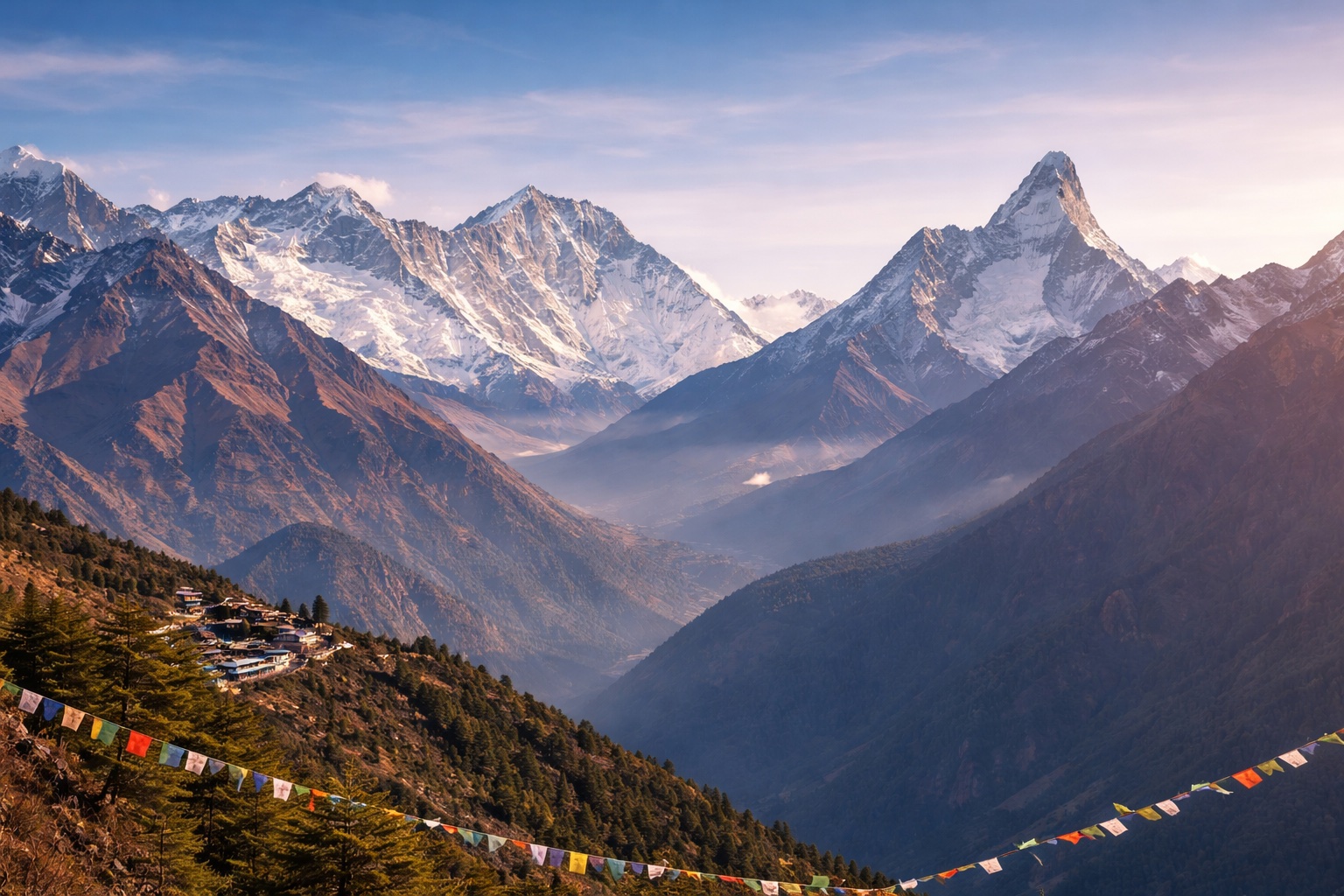
  • Afternoon prayers at Tengboche Monastery, with Ama Dablam behind
  • The quiet memorials at Thukla, above Pheriche
  • Two acclimatisation days, so you get up safely

Everest Base Camp Trek overview

People tend to picture the Everest Base Camp trek as one long walk to a famous spot. It's really a slow climb through a whole world. The first days are green: pine forest, the milky blue Dudh Koshi river, suspension bridges hung with prayer flags, and villages where kids walk to school in the same trainers you'd wear to the gym. By day five the trees are gone. By day eight you're walking beside a glacier at nearly 5,000 metres, and the lodges are small stone buildings with one stove and a lot of people around it.

That change is what makes the trek. Base camp itself is a rocky stretch of moraine at the foot of the Khumbu Icefall, and from there you can't actually see Everest's summit. The view everyone comes for is from Kala Patthar, a dark hill above Gorak Shep that you climb in the cold before sunrise. When the light hits the top of Everest from there, nobody talks much.

The trek in numbers

Length14 days from Kathmandu; 12 of them on the trail
DistanceAbout 130 km there and back from Lukla
Highest pointKala Patthar, 5,545 m (18,192 ft)
Everest Base Camp5,364 m (17,598 ft)
GradeStrenuous, but no climbing
Walking5–7 hours most days; 7–8 on the two biggest days
Best monthsMarch to May, late September to November

How the route goes

After a night in Kathmandu you fly to Lukla, which in the busy months means a pre-dawn drive to Ramechhap first. The first afternoon is short: a couple of hours downhill to Phakding. Day three is the first real test, a long climb from the river up to Namche Bazaar. Take it slowly. On a clear day you'll catch your first glimpse of Everest about halfway up, over the ridge to the right, and you'll probably have to ask your guide which peak it is, because it looks smaller than you expect.

You spend two nights in Namche. The "rest day" isn't really a rest: we walk up to the Everest View Hotel or Khumjung and come back down, which helps your body adjust. Then the trail follows a high path above the river to Tengboche, where the monastery sits on a ridge with Ama Dablam behind it, and on to Dingboche in the Imja valley for the second acclimatisation stop.

From Dingboche it's up past the climbers' memorials at Thukla to Lobuche, and then the big day: along the edge of the Khumbu Glacier to Gorak Shep, lunch, and on to base camp. You sleep at Gorak Shep, the highest and coldest night of the trip, and leave for Kala Patthar at around 4:30 the next morning. After that it's downhill, and it's remarkable how much better everyone feels by the time they reach Pheriche. Two more days take you back through Namche to Lukla, and a morning flight gets you to Kathmandu.

StageDistanceWalkingSleep at
Lukla – Phakding8 km3–4 h2,610 m
Phakding – Namche Bazaar11 km5–6 h3,440 m
Namche – Tengboche10 km5–6 h3,860 m
Tengboche – Dingboche11 km5–6 h4,410 m
Dingboche – Lobuche8.5 km5–6 h4,940 m
Lobuche – Gorak Shep – Base Camp – Gorak Shep12 km7–8 h5,164 m
Gorak Shep – Kala Patthar – Pheriche13 km7–8 h4,240 m
Pheriche – Namche Bazaar15 km6–7 h3,440 m
Namche – Lukla18 km6–7 h2,860 m

Times include short breaks but not lunch. Don't worry about distance; it's the height that slows you down.

How hard is it, honestly?

Harder than most people expect, and easier than they fear. The trails are good and there's no scrambling or ropes. What wears you down is doing five to seven hours a day, several days in a row, with less and less oxygen. Above Dingboche, a flight of steps that wouldn't bother you at home will have you stopping to breathe.

If you can walk for a full day in hills, get up and do it again the next day, you can do this trek. Age matters much less than people think. Fit trekkers in their sixties and seventies reach base camp every season, while the occasional marathon runner struggles because they went up too fast. Fitness helps. Patience helps more.

Altitude: the part that actually matters

Almost everyone feels the height a bit. A dull headache in the evening, a poor night's sleep, not wanting to finish your dinner: that's normal in the first night or two at a new altitude. What isn't normal is a headache that painkillers don't touch, vomiting, confusion, or being unusually breathless while resting. If that happens, you go down. Every time. It's the one rule our guides won't bend.

That's why this itinerary has two acclimatisation days and never climbs more than about 500 metres in sleeping height above Namche. Your guide carries a pulse oximeter and checks your oxygen levels and heart rate each evening. It's quick and a bit of a ritual; people end up comparing numbers over dinner. Drink three or four litres a day, go easy on alcohol until you're back in Namche, and talk to your doctor before you come about whether altitude medication is right for you.

When to go

October and November give the clearest skies of the year, and it's the busiest time on the trail. Spring (March to May) is warmer, the rhododendrons are out in the lower forests, and in April and May the expedition tents fill base camp, which is a sight in itself. Winter is cold, very quiet and often beautifully clear, as long as you're happy with nights of −15°C or lower at Gorak Shep. The monsoon, June to August, brings cloud, mud lower down and a lot of cancelled Lukla flights; we don't recommend it unless you're flexible.

Whatever the season, temperatures swing hard. You can walk in a T-shirt at midday below Namche and need every layer you own that same night. Mornings are almost always the clearest part of the day, which is why we start early.

Lodges, food and the little costs

You sleep in teahouses, which are family-run lodges with small twin rooms, thin walls and a dining room with a stove that's lit in the evening. Lower down many rooms have their own bathroom; higher up you'll share, and you'll be grateful for a warm sleeping bag. Lodge owners are proud of their places and most are spotless for how remote they are.

Food is better than people expect. Dal bhat (rice, lentil soup, curry and pickle, with refills) is what the guides eat, and it's the best fuel you'll find. There's also pasta, noodle soup, fried rice, potatoes in every form, porridge and eggs, and Namche's bakeries do a decent apple pie. We suggest skipping meat above Namche, because it's carried up without refrigeration.

Your meals are included. What isn't: hot drinks between meals, snacks, showers, charging and Wi-Fi. They get more expensive as you climb, simply because everything has come up on someone's back. Bring cash in rupees; cards rarely work on the trail and the ATMs in Lukla and Namche aren't reliable.

Permits and the guide rule

You need two permits, the Sagarmatha National Park entry permit and the local Khumbu Pasang Lhamu Rural Municipality fee, and we sort out both. Since 2023, most foreign trekkers in Nepal's national parks also have to walk with a licensed guide, which is included in this trip anyway.

The Lukla flight, and why we ask for a spare day

The flight to Lukla is short, about 35 minutes, and it lands on a steep runway cut into the hillside. It also depends completely on the weather at both ends. Delays of a day happen every season, and occasionally longer. We handle rebooking, but we strongly suggest keeping one or two free days in Kathmandu before your flight home. If you run out of time, a helicopter is usually possible at extra cost.

The baggage limit is around 15 kg in total, including your daypack. Leave everything else at your Kathmandu hotel; it'll be waiting when you get back.

Getting fit for it

Two to three months of regular walking makes a real difference. The best training is simply walking uphill for hours with a pack on, and doing it on consecutive days. If you live somewhere flat, stairs and a stepper will do. Add some squats and lunges for the descents, which are hard on the knees. And wear your boots on those walks. New boots on the trail are the most common cause of blisters we see.

A few things people don't expect

  • You can't see Everest's summit from base camp. It's hidden behind its own West Shoulder. Kala Patthar is where the view is.
  • The dry air gets to your throat. A cough is common above Pheriche. A buff over your mouth on cold mornings helps.
  • Your appetite drops. Eat anyway. Soup and garlic soup, which every lodge swears by, are easier than a big plate.
  • Going down is easier on the lungs but harder on the knees. Poles help a lot on the steep sections below Namche.
  • It gets sociable. By the second week you'll know people from half a dozen countries by the stove each evening.

Sherpa country

The Khumbu is the home of the Sherpa people, who came over the mountains from Tibet several hundred years ago. Buddhism is part of every day here. You'll pass carved mani stones and prayer wheels, walk under strings of prayer flags and hear the monks at Tengboche in the afternoon. Keep chortens and mani walls on your right as you pass, ask before photographing people, and dress with a bit of care in villages and monasteries. Many of the lodge families have climbed Everest themselves, or have fathers and uncles who did. Ask them about it.

What the price covers

The price is per person and goes down for larger groups (see the price box). It covers airport transfers, two hotel nights in Kathmandu, return flights to Lukla, both permits, your lodges and three meals a day on the trek, a licensed guide, porters, and their wages, food and insurance. You'll need to budget separately for international flights, your visa, travel insurance that covers trekking to 5,600 m and helicopter rescue, drinks and extras on the trail, and tips for your guide and porters at the end.

Helicopter out, or a few more days

If you're short on time, you can fly out by helicopter from Gorak Shep or Pheriche after Kala Patthar instead of walking back down. You save two or three days and get a remarkable flight down the valley. If you have more time, the Gokyo Lakes loop over the Cho La is our guides' favourite extension, and fit trekkers can add Island Peak (6,165 m) after base camp. Ask us and we'll work out the extra days and cost.

Why trek with us

We're a small team based in Kathmandu, and we plan every trek ourselves. Our guides are from the mountain regions, they're licensed and first-aid trained, and our porters carry sensible loads, are paid fairly and are insured. We keep the itinerary realistic because we'd rather you reach base camp feeling reasonably good than race up and spend the best day of the trip with a headache. If you'd like to talk it through before you book, send us a message. A real person in our office will answer, usually within a day.

Day-by-day itinerary

Day1
Welcome to Nepal. Someone from our office will meet you at arrivals and take you to your hotel. Later in the day you'll meet your guide, go through the plan and check your gear. If anything's missing, Thamel's shops are a short walk away and much cheaper than at home.
1,400 m Hotel
Day2
An early start: the flight leaves from Kathmandu, or from Ramechhap in the busiest months, which means a very early drive. The landing at Lukla is short and steep; sit on the left if you can. After tea you meet your porters and walk mostly downhill to Phakding, past mani stones and small farms. It's an easy first afternoon on purpose.
3–4 hours 2,860 m Breakfast, lunch, dinner Teahouse lodge Flight and trek 8 km
Day3
Follow the river north, back and forth over suspension bridges, to Monjo and the national park gate. The high Hillary Bridge marks the start of the long climb to Namche. Go slowly here, even if you feel strong. On a clear day you'll get your first look at Everest from a bend in the trail about halfway up.
5–6 hours 3,440 m Breakfast, lunch, dinner Teahouse lodge Trek 11 km
Day4
A day to let your body catch up. We walk up to the Everest View Hotel or the village of Khumjung for views of Everest, Lhotse and Ama Dablam, then come back to Namche to sleep. The afternoon is yours: the Sherpa Culture Museum, a bakery, or a nap.
3–4 hours 3,880 m Breakfast, lunch, dinner Teahouse lodge Acclimatisation hike
Day5
One of the best walks of the whole trek. The path contours high above the river with Ama Dablam straight ahead, drops to Phunki Tenga for lunch, then climbs through forest to Tengboche. If you're not too tired, sit in on the monks' afternoon prayers.
5–6 hours 3,860 m Breakfast, lunch, dinner Teahouse lodge Trek 10 km
Day6
Down through the forest to Deboche, over the river and up past Pangboche, where the old monastery is worth a quick look. The trees thin out and the valley opens into yak pastures. Dingboche is a village of stone-walled potato fields sitting right under Ama Dablam.
5–6 hours 4,410 m Breakfast, lunch, dinner Teahouse lodge Trek 11 km
Day7
Your second rest day, and an important one. We climb part or all of Nangkartshang Peak (about 5,080 m) for a view that stretches to Makalu, then come back down to sleep. Most people feel noticeably better the next day because of it.
4–5 hours 5,080 m Breakfast, lunch, dinner Teahouse lodge Acclimatisation hike
Day8
Across the open valley above Pheriche to Thukla, then a short, steep climb to the memorials for climbers who died on Everest. It's a quiet place; people usually slow down here without being asked. The last stretch follows the glacier moraine to Lobuche, with Nuptse right above you.
5–6 hours 4,940 m Breakfast, lunch, dinner Teahouse lodge Trek 8.5 km
Day9
The big day. We leave early, walk along the moraine to Gorak Shep and have an early lunch, then carry on over rock and ice to base camp beside the Khumbu Icefall. In spring the expedition tents are there; in autumn it's often just you, the glacier and the prayer flags. Back to Gorak Shep for the coldest night of the trip.
7–8 hours 5,364 m Breakfast, lunch, dinner Teahouse lodge Trek 12 km
Day10
Headtorches on at around 4:30 for the climb up Kala Patthar. It's steep and cold, and it's worth it: Everest, Nuptse, Lhotse and Pumori light up one after another as the sun comes over. Back to Gorak Shep for breakfast, then down past Lobuche to Pheriche, where the air feels thick and you'll sleep better than you have in days.
7–8 hours 5,545 m Breakfast, lunch, dinner Teahouse lodge Trek 13 km
Day11
A long day, but mostly downhill, back through Pangboche and Tengboche and along the high path to Namche. It's the first hot shower in a while for a lot of people, and usually a celebration dinner.
6–7 hours 4,240 m Breakfast, lunch, dinner Teahouse lodge Trek 15 km
Day12
Down to the river, over the bridges one last time and back through Monjo and Phakding to Lukla. The last hour is uphill, which nobody enjoys. In the evening there's usually a small party with the porters and your guide.
6–7 hours 3,440 m Breakfast, lunch, dinner Teahouse lodge Trek 18 km
Day13
An early flight to Kathmandu, or to Ramechhap with a drive back, then the rest of the day free. This day also doubles as a buffer if the weather holds up the flight. If all goes to plan, go and see Boudhanath at sunset.
2,860 m Breakfast Hotel
Day14
We'll take you to the airport in time for your flight. If you have a few more days, Pokhara, Chitwan or the old cities of the Kathmandu Valley are easy to add.
1,400 m Breakfast

What’s included

Included

  • Airport pick-up and drop-off in private vehicles
  • 2 nights in a hotel in Kathmandu with breakfast (before and after the trek)
  • Return flights Kathmandu (or Ramechhap) – Lukla, with transfer to Ramechhap when flights operate from there
  • Sagarmatha National Park permit and Khumbu Pasang Lhamu Rural Municipality permit
  • Teahouse lodge accommodation during the trek (11 nights, twin sharing)
  • Breakfast, lunch and dinner during the trek
  • Licensed, English-speaking trekking guide trained in first aid
  • Porters (1 porter for 2 trekkers), with their wages, food, lodging and insurance
  • Guide and porter flights, wages, meals, accommodation and insurance
  • First-aid kit and pulse oximeter carried by the guide
  • Sleeping bag and down jacket on loan if needed (to return after the trek)
  • Trekking map and company duffel bag
  • All government and local taxes

Not included

  • International flights to and from Kathmandu
  • Nepal visa fee
  • Travel insurance covering trekking to 5,600 m and helicopter evacuation (compulsory)
  • Lunch and dinner in Kathmandu
  • Drinks, snacks, hot showers, battery charging and Wi-Fi on the trek
  • Extra nights in Kathmandu or on the trek caused by early return, flight delays or cancellations
  • Helicopter evacuation or charter
  • Personal equipment and expenses
  • Tips for your guide and porters

Dates & prices

Dates
Availability
6 Oct 2026→19 Oct 2026
Available
21 Oct 2026→3 Nov 2026
Available
5 Nov 2026→18 Nov 2026
Available

Useful info

Fitness

You'll walk five to seven hours most days, on and off for twelve days. Two or three months of long hill walks, ideally on back-to-back days and with a daypack, is the best preparation. Wear in your boots on those walks, not on the trail.

Altitude

A mild headache or a poor night's sleep is normal the first night at a new height. A headache that won't shift, vomiting, confusion or breathlessness at rest are not, and the answer is to go down. Drink three to four litres a day, skip the alcohol until Namche on the way back, and ask your doctor before the trip about altitude medication.

Weather

Midday below Namche can be T-shirt weather. Nights above 4,000 m are below freezing, and Lobuche and Gorak Shep are the coldest. Carry a warm layer and a waterproof every day, even when the morning looks perfect.

Lukla baggage limit

About 15 kg in total per person, usually 10 kg in the hold and 5 kg in your hand luggage. Anything you don't need can stay at your Kathmandu hotel.

Money and charging

Bring enough rupees from Kathmandu for drinks, snacks, showers, charging and Wi-Fi cards. There are ATMs in Lukla and Namche, but don't count on them. A power bank saves you money and hassle.

Water

Plastic bottles are discouraged in the national park, and rightly so. Fill up with boiled or filtered water at lodges, or treat tap water with tablets or a filter.

Insurance

Compulsory. It needs to cover trekking to 5,600 m, medical treatment and helicopter evacuation, and plenty of standard policies don't, so check the altitude limit. Send us your policy details before you arrive.

Visa

Most nationalities can get a tourist visa on arrival at Kathmandu airport or apply online beforehand. Your passport needs six months' validity; bring a couple of passport photos for permits.

Packing list

Clothing

  • Moisture-wicking base layers (top and bottom)
  • Fleece jacket or mid-layer
  • Warm down jacket (can be borrowed from us)
  • Waterproof and windproof jacket and trousers
  • Trekking trousers and shirts
  • Warm hat, sun hat and buff
  • Liner gloves and insulated gloves
  • Trekking socks and warm sleeping socks

Footwear

  • Broken-in waterproof trekking boots
  • Camp shoes or sandals for the lodges
  • Gaiters (useful in winter and spring)

Equipment

  • Sleeping bag rated to about −15°C (can be borrowed from us)
  • Daypack of 25–35 litres with rain cover
  • Trekking poles
  • Head torch with spare batteries
  • Two 1-litre water bottles and purification tablets
  • Sunglasses with UV protection
  • Power bank and charging cables

Personal items

  • High-factor sunscreen and lip balm
  • Personal first-aid kit and medication
  • Toiletries, quick-dry towel and wet wipes
  • Snacks such as energy bars and nuts
  • Passport, insurance details and copies

Add-ons & trip options

Extra night in Kathmandu hotel (per room, with breakfast)US$60
Single room supplement in Kathmandu (2 nights)US$80
Kathmandu Valley sightseeing day tour (guide, vehicle and entrance fees)US$95
Extra porter for the whole trekUS$280
Everest mountain flight from Kathmandu (per person)US$230
Helicopter return Gorak Shep to Kathmandu (per person, shared)US$1,150
Chitwan jungle safari extension, 2 nights (per person)US$320

Choose add-ons and quantities on the booking form.

Things we can add or change. Ask and we'll quote you:

  • Helicopter back from Gorak Shep or Pheriche, saving two or three days of walking.
  • Gokyo Lakes and the Cho La: four or five extra days, and our guides' favourite corner of the Khumbu.
  • Island Peak (6,165 m) after base camp, with a climbing guide and permit: about four extra days.
  • A private trek on your own dates, at your own pace.
  • An extra rest day anywhere on the way up, if you'd like more time to adjust.
  • A day in the Kathmandu Valley with a guide, before or after the trek.

Frequently asked questions

This itinerary is 14 days door to door in Kathmandu, with 12 days on the trail and two of those as acclimatisation days. You can do it faster, but most of the problems we see come from people rushing.

It's strenuous, but it isn't technical. The trails are good; the hard part is walking five to seven hours a day at high altitude, and the last few days above 4,900 m. If you can hike all day and do it again the next day, you can manage it with some training.

Yes. Plenty of people do this as their first proper trek. What matters is preparing for a couple of months, walking at a steady pace and listening to your guide. If you'd like a warm-up first, Poon Hill or Langtang are good choices.

October and November for clear skies, March to May for warmer days, flowers and the expedition camps at base camp. Winter works if you don't mind the cold. We'd avoid June to August unless your dates are flexible.

Not the summit. It's hidden behind the mountain's West Shoulder. The full view is from Kala Patthar, which you climb at sunrise the morning after base camp. You also see Everest from the trail above Namche and from Tengboche.

Yes. Since 2023 most foreign trekkers in Nepal's national parks have to walk with a licensed guide. It's included in this trip.

Mild symptoms usually settle with rest, water and an extra night at the same height. If they get worse, you go down with a member of our team, and if it's serious we arrange a helicopter. That's one reason your insurance has to cover evacuation.

Days can be warm in the sun lower down. Nights above 4,000 m are below freezing, and at Gorak Shep they're usually somewhere between −5°C and −15°C in spring and autumn, colder in winter. Bring a proper down jacket; we can lend you one, and a sleeping bag, if needed.

We rebook you on the next flight and shift the plan around. This is why we ask you to keep a spare day or two in Kathmandu at the end. If time runs out, a helicopter can usually be arranged at extra cost.

In most villages, yes. Lodges sell Wi-Fi cards, and mobile data works in a lot of places, although it gets patchy near base camp. It's not a bad trek to be a bit offline for.

Most lodges have hot showers and charging for a small fee, which goes up as you climb. At the highest lodges, showers may not be possible when it's very cold. A power bank is worth bringing.

Besides flights, visa and insurance, plan for drinks and snacks on the trail, showers, charging and Wi-Fi, and tips for your guide and porters at the end. Bring cash in rupees; cards rarely work up there.

Yes. Any date works for a private trek, and we can add rest days, a helicopter back, or an extension to Gokyo or Island Peak.

For October, November, April and May, two to four months ahead is sensible, mostly because of the Lukla flights. In quieter months we can often arrange things at short notice.

Traveller reviews