
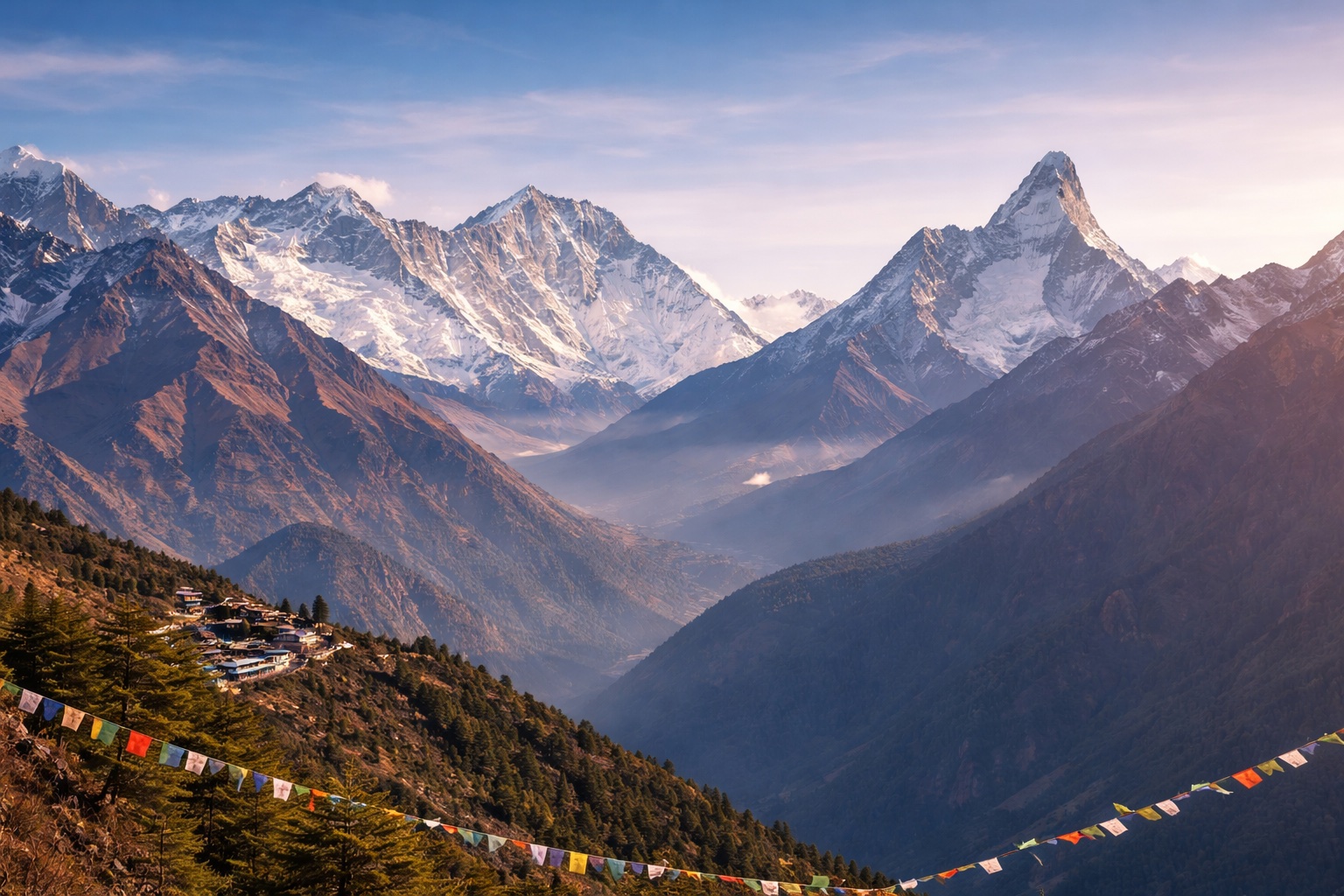
Dhaulagiri Circuit Trek
The Dhaulagiri Circuit trek is an 18-day, fully supported camping trek around Dhaulagiri I (8,167 m), the seventh-highest mountain in the world. Walk up the Myagdi valley from Darbang to Italian Base Camp, cross the Chhonbardan Glacier to Dhaulagiri Base Camp, then go over French Pass (5,360 m) into the empty bowl of Hidden Valley and down over Dhampus Pass to the apple orchards of Marpha in the Kali Gandaki valley.
Graded strenuous, it is one of the wildest and most remote treks in Nepal and is best suited to trekkers who have already been above 5,000 m. Our experienced camp crew carries tents and food and cooks three hot meals a day. Permits, guides, cook, porters, camping equipment, transport and the Jomsom–Pokhara flight are included.
Trip highlights
- Circle Dhaulagiri I (8,167 m), seventh-highest mountain in the world
- Cross French Pass (5,360 m) and Dhampus Pass (about 5,240 m)
- Camp in Hidden Valley at around 5,050 m
- Walk the Chhonbardan Glacier to Dhaulagiri Base Camp
- Magar villages in the Myagdi valley and Thakali Marpha
Short itinerary
View detailed itinerary- Day 1 Arrival in Kathmandu (1,400 m) 1,400 m
- Day 2 Drive or fly to Pokhara (820 m) 820 m
- Day 3 Drive to Darbang (1,110 m) 1,110 m
- Day 4 Trek to Dharapani (1,560 m) 1,560 m
- Day 5 Trek to Muri (1,850 m) 1,850 m
- Day 6 Trek to Boghara (2,080 m) 2,080 m
- Day 7 Trek to Dobang (2,520 m) 2,520 m
- Day 8 Trek to Choriban Khola (3,110 m) 3,110 m
- Day 9 Trek to Italian Base Camp (3,660 m) 3,660 m
- Day 10 Acclimatisation day at Italian Base Camp 3,900 m
- Day 11 Trek to Glacier Camp (4,200 m) 4,200 m
- Day 12 Trek to Dhaulagiri Base Camp (4,750 m) 4,750 m
- Day 13 Cross French Pass (5,360 m) to Hidden Valley (5,050 m) 5,360 m
- Day 14 Cross Dhampus Pass (5,240 m) to Yak Kharka (3,680 m) 5,240 m
- Day 15 Trek to Marpha (2,670 m), drive to Jomsom (2,720 m) 2,720 m
- Day 16 Fly to Pokhara (820 m) 820 m
- Day 17 Return to Kathmandu 1,400 m
- Day 18 Departure from Kathmandu 1,400 m
Dhaulagiri Circuit Trek overview
Quick answer: the Dhaulagiri Circuit takes 18 days from Kathmandu, reaches 5,360 m at French Pass, includes about seven nights of camping on glaciers and high passes, and costs from US$2,790 per person. It is graded strenuous.
The circuit is a proper expedition-style trek. For the first few days you walk through Magar villages and forest, staying in simple lodges. Above Boghara the villages end, and from there to Yak Kharka, on the far side of Dhampus Pass, you camp. The route crosses the moraine-covered Chhonbardan Glacier beneath the huge north face of Dhaulagiri, spends a night in Hidden Valley at around 5,050 m, and finishes with the descent into the Kali Gandaki, the deep gorge between Dhaulagiri and Annapurna.
Dhaulagiri Circuit at a glance
| Trip fact | Details |
|---|---|
| Duration | 18 days (13 days of trekking) |
| Maximum altitude | French Pass, 5,360 m |
| Other pass | Dhampus Pass, about 5,240 m |
| Grade | Strenuous |
| Start and finish | Darbang (by road from Pokhara); Marpha and Jomsom (flight to Pokhara) |
| Accommodation | Lodges for the first days, then full camping |
| Permits | Annapurna Conservation Area permit and local fees |
| Best time | Late September–November, April–May |
| Cost | From US$2,790 per person |
Why choose the Dhaulagiri Circuit?
- Wilderness: a week with no villages and very few other trekkers.
- Dhaulagiri up close from Italian Base Camp and Dhaulagiri Base Camp.
- French Pass and Hidden Valley, a high, silent basin surrounded by snow peaks.
- Glacier walking on the Chhonbardan Glacier.
- Finish in Marpha, the apple capital of the Kali Gandaki.
Who is it for?
This trek is for experienced trekkers. You should already have trekked above 5,000 m, be comfortable on loose, rough ground and steep snow slopes, and be happy camping in temperatures down to −15°C or lower. No mountaineering skills are needed, but your guide may use fixed ropes on steep sections and ask you to wear microspikes or crampons, depending on conditions.
Our camp crew
On the camping section you are supported by a lead guide, an assistant guide, a cook, kitchen staff and porters. We provide sleeping tents, a dining tent, a kitchen tent and a toilet tent, sleeping mats, and all meals. Our porters on this route are properly equipped with boots, warm clothes, sunglasses and insurance for the passes.
Day-by-day itinerary
What’s included
Included
- Airport pick-up and drop-off in private vehicles
- 2 nights in Kathmandu and 2 nights in Pokhara with breakfast
- Tourist bus Kathmandu – Pokhara – Kathmandu (flights can be added)
- Jeep Pokhara – Darbang and Marpha – Jomsom
- Flight Jomsom – Pokhara
- Annapurna Conservation Area permit and local fees
- Lodge accommodation for the first nights and fully supported camping on the trek
- All meals during the trek, prepared by our cook
- Sleeping tents, dining, kitchen and toilet tents, mats and cooking equipment
- Licensed lead guide, assistant guide, cook, kitchen staff and porters with wages, food, equipment and insurance
- Fixed ropes and group safety equipment; satellite communication device
- All government and local taxes
Not included
- International flights to and from Kathmandu
- Nepal visa fee
- Travel insurance covering trekking to 5,500 m and helicopter evacuation (compulsory)
- Lunch and dinner in Kathmandu and Pokhara
- Drinks, snacks, hot showers, battery charging and Wi-Fi on the trek
- Extra nights caused by early return, flight delays, landslides or cancellations
- Helicopter evacuation or charter
- Personal equipment and expenses
- Tips for your guide and porters
Useful info
Fitness and preparation
This is a hard trek. You should be fit, comfortable walking 7–8 hours on rough ground for several days in a row, and have previous experience of trekking above 5,000 m. Train for at least three months with long hill days carrying a pack, stair climbing and cardio.
Altitude sickness
The highest point is 5,360 m at French Pass, with nights at about 4,750 m at base camp and 5,050 m in Hidden Valley. Most people feel the altitude a little: a mild headache, poor sleep, less appetite. Go slowly, drink 3–4 litres a day, skip the beer until you are back down, and tell your guide straight away if you feel worse. Going down is the cure that always works. Ask your doctor before you travel whether altitude medication makes sense for you.
Weather and temperatures
Lower valleys are warm; above Italian Base Camp nights are well below freezing, often −10°C to −20°C in Hidden Valley in autumn. Snow can fall on the passes at any time, and we may wait a day for conditions to improve.
Domestic flights and baggage
The Jomsom – Pokhara flight leaves in the early morning and is sometimes cancelled because of wind; in that case we drive back to Pokhara.
Permits
The Annapurna Conservation Area permit and local fees are included. No restricted area permit is needed.
Money, charging and Wi-Fi
Carry Nepali rupees for drinks, snacks, showers and charging, and get them in the city; mountain ATMs are rare and unreliable. Wi-Fi is available in many lodges for a small fee. A power bank is worth packing.
Drinking water
Buy boiled or filtered water at lodges or use purification tablets or a filter with a refillable bottle, instead of buying plastic bottles.
Travel insurance
You need travel insurance that covers trekking to 5,500 m, medical care and helicopter rescue. We ask for your policy details before you arrive.
Visa
You can usually get a Nepal visa on arrival at the airport or apply online in advance. Check that your passport is valid for at least six months, and pack a few passport photos for permits.
Packing list
Clothing
- Moisture-wicking base layers
- Fleece jacket or mid-layer
- Warm down jacket (can be borrowed from us)
- Waterproof and windproof jacket and trousers
- Trekking trousers and shirts
- Warm hat, sun hat and buff
- Liner gloves and insulated gloves
- Trekking socks
Footwear
- Broken-in waterproof trekking boots
- Camp shoes or sandals for the lodges
Equipment
- Sleeping bag rated to about −20°C (can be borrowed from us)
- Daypack of 25–35 litres with rain cover
- Trekking poles
- Head torch with spare batteries
- Water bottles and purification tablets
- Sunglasses with UV protection
- Power bank and charging cables
- Microspikes or crampon-compatible boots (we advise before departure)
- Gaiters
- Category 4 glacier glasses
- Warm mitts and insulated trousers
- Solar charger (no electricity on the camping section)
Personal items
- High-factor sunscreen and lip balm
- Personal first-aid kit and medication
- Toiletries, quick-dry towel and wet wipes
- Snacks such as energy bars and nuts
- Passport, insurance details and copies
Add-ons & trip options
Choose add-ons and quantities on the booking form.
More trip options, quoted on request:
- Extra weather day before the passes.
- Tatopani and Ghorepani extension down the Kali Gandaki.
- Helicopter return from Yak Kharka or Marpha.
Frequently asked questions
18 days from Kathmandu, including 13 days of trekking.
5,360 m, the highest point of the trek.
It is strenuous, with glacier walking, two passes above 5,200 m and nights at around 5,000 m.
Yes. We use lodges for the first few nights and full camping from around Boghara to Yak Kharka.
From US$2,790 per person, including the camping crew, all meals on the trek, permits, transport and the Jomsom flight.
No, but previous trekking above 5,000 m is strongly recommended. Microspikes or crampons and fixed ropes may be used.
Late September to November is best, followed by April–May.
The Annapurna Conservation Area permit and local fees, included in the price.
Nights at base camp and in Hidden Valley are often −10°C to −20°C.
We wait for a safe window. If conditions don't improve, we descend the way we came.
Not on most of the camping section. Our guides carry a satellite device for emergencies.
Yes. We can rent down jackets and sleeping bags in Kathmandu, and advise on microspikes.