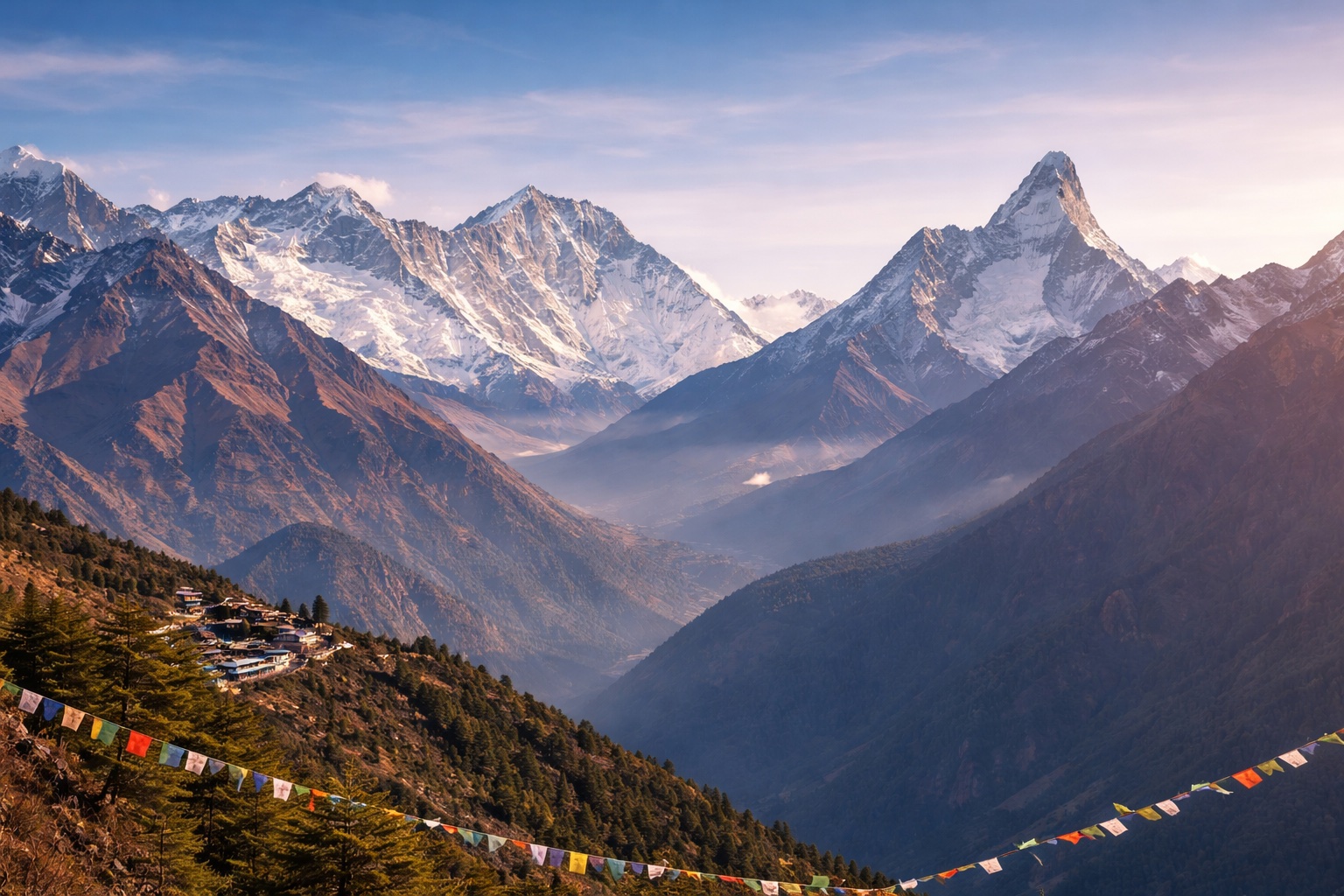
The Manaslu Circuit trek is a 15-day guided trek around Manaslu (8,163 m), the eighth-highest mountain in the world, in a restricted area of west-central Nepal. Follow the deep Budhi Gandaki gorge from subtropical villages to the Tibetan Buddhist communities of the Nubri valley, spend an acclimatisation day in Samagaun (3,530 m) beneath Manaslu's glaciers, and cross the Larkya La pass (5,106 m) into the Annapurna region.
Often described as the Annapurna Circuit before the roads arrived, the Manaslu Circuit is quieter, wilder and more traditional. It is graded strenuous and is best from March–May and September–November. Restricted area permits require a licensed guide and at least two trekkers; we arrange the Manaslu Restricted Area Permit, conservation area permits, guide, porters, private transport and teahouse lodges with meals.
For trekkers who want the adventure of a classic Himalayan circuit without the crowds, the Manaslu Circuit is one of the best treks in Nepal. The route opened to foreign trekkers in 1991 and still sees only a fraction of the visitors of the Everest and Annapurna trails. It follows an ancient salt-trading route between Nepal and Tibet, through villages where life still revolves around barley fields, yak herds and Buddhist monasteries.
The landscapes change dramatically on the way: from rice terraces and waterfalls in the lower Budhi Gandaki valley, through pine forest, to the high, open valley of Nubri with its long mani walls and chortens, and finally the glaciers and ice walls around Manaslu and the high crossing of the Larkya La.
| Trip fact | Details |
|---|---|
| Duration | 15 days from Kathmandu (10 days of trekking) |
| Trek distance | About 170 km |
| Highest point | Larkya La pass, 5,106 m (16,752 ft) |
| Grade | Strenuous |
| Daily walking | 6–7 hours; 8–10 hours on the pass day |
| Start and finish | Kathmandu, by road to Machha Khola and back from Dharapani |
| Accommodation | Hotel in Kathmandu, teahouse lodges on the trek |
| Permits | Manaslu Restricted Area Permit, MCAP and ACAP |
| Rules | Minimum 2 trekkers with a licensed guide |
| Best time | March–May and September–November |
A long drive from Kathmandu via Dhading Besi and Arughat reaches Machha Khola in the lower Budhi Gandaki valley. The trail follows the river north through Jagat, where permits are checked, and Deng, then turns west around the mountain into the Nubri region at Namrung. Villages such as Lho and Samagaun offer close views of Manaslu, and an acclimatisation day at Samagaun allows a hike towards Manaslu Base Camp or to Pungyen Gompa.
From Samdo, a village of Tibetan origin near the border, you climb to Dharamsala (Larkya Phedi) and cross the Larkya La before dawn the next day. The descent leads to the glacial meadows of Bimthang and down through forest to Dharapani, on the Annapurna Circuit, where a jeep takes you back towards Kathmandu.
Manaslu is a restricted area. You need the Manaslu Restricted Area Permit, the Manaslu Conservation Area Permit (MCAP) and the Annapurna Conservation Area Permit (ACAP) for the descent. Restricted area permits are issued only through a registered agency to groups of at least two trekkers with a licensed guide. All permits are included in this trip. If you are travelling alone, contact us and we will explain the options.
The Manaslu Circuit is graded strenuous. The days in the lower gorge include many ascents and descents on rough trails, and the pass day is long: an early start from Dharamsala at about 4,460 m, a climb over moraine to the Larkya La at 5,106 m, and a steep descent to Bimthang. Previous multi-day trekking experience and good fitness are recommended.
The route gains height gradually, which helps acclimatisation, and this itinerary includes a rest day at Samagaun (3,530 m) and a night at Samdo before the high camp at Dharamsala. Your guide monitors each trekker daily, carries a first-aid kit and pulse oximeter, and will adjust the plan if anyone shows signs of altitude sickness.
Autumn (September–November) is the best season, with clear skies and a snow-free pass. Spring (March–May) is also excellent, with rhododendrons in the lower forests; early March can bring snow on the Larkya La. In winter, heavy snow often closes the pass, and during the monsoon the lower valley is affected by rain and landslides.
Teahouse lodges now operate along the whole circuit. They are simpler than on the Everest and Annapurna trails, with basic twin rooms and shared bathrooms in the higher villages. At Dharamsala, accommodation is very basic. Meals are simple and filling: dal bhat, noodles, Tibetan bread, potatoes and soups. There are no ATMs on the circuit, so bring enough cash from Kathmandu.
Both circle a great massif and cross a pass above 5,000 m. The Manaslu Circuit is quieter, more remote and less affected by roads, with stronger Tibetan culture. The Annapurna Circuit has more facilities, more flexibility and a higher pass. Some trekkers combine them by continuing from Dharapani onto the Annapurna Circuit.
You should be comfortable walking 6–7 hours a day for many days on rough mountain trails, with one very long pass day. Previous multi-day trekking experience is recommended. Train for at least three months.
This trek reaches 5,106 m on the Larkya La. Symptoms of acute mountain sickness include headache, nausea, dizziness, loss of appetite and poor sleep. Walk slowly, drink 3–4 litres of water a day, avoid alcohol and tell your guide about any symptoms. If symptoms get worse, descending is the most effective treatment. Talk to your doctor before the trip about whether altitude medication is right for you.
The lower gorge is warm and humid; nights above Samagaun are cold, and the pass can be very cold and windy before dawn. Snow can fall on the pass in early spring and late autumn.
The Manaslu Restricted Area Permit, MCAP and ACAP are included. Restricted area permits require at least two trekkers and a licensed guide; bring your passport and several passport photos.
Take out cash in Kathmandu or Pokhara before you set off: there are very few ATMs on the trail, and the ones that exist often don't work. Lodges charge a little for hot showers, charging and Wi-Fi, so a power bank saves money.
Bring a refillable bottle and either purification tablets or a filter. Lodges also sell boiled water, which is cheaper and better for the trail than bottled water.
Travel insurance is compulsory. It must cover trekking to 5,500 m, medical treatment and emergency helicopter evacuation. Please send us your policy details before departure.
Most visitors get a tourist visa on arrival at Kathmandu airport, or apply online before they fly. Your passport needs six months' validity, and bring a few passport photos for trekking permits.
Choose add-ons and quantities on the booking form.
More trip options, quoted on request:
This itinerary takes 15 days from Kathmandu, with 10 days of trekking, an acclimatisation day in Samagaun and a reserve day in Kathmandu.
Yes. You need the Manaslu Restricted Area Permit, MCAP and ACAP, all included. Restricted area permits require at least two trekkers and a licensed guide.
Restricted area permits are issued only for groups of at least two trekkers with a licensed guide. If you are travelling alone, contact us and we will explain the options.
It is strenuous, with long days on rough trails and a pass day of 8–10 hours over the Larkya La (5,106 m). Previous trekking experience is recommended.
September–November and March–May. Heavy snow often closes the pass in winter, and the monsoon brings landslides to the lower valley.
Yes, teahouses operate along the whole route, although they are simpler than on the Everest and Annapurna trails. Dharamsala, below the pass, is very basic.
Manaslu is quieter, more remote and more traditional; Annapurna has more facilities and a higher pass. Both are superb, and they can be combined.
Mobile signal and Wi-Fi are available in some villages but are limited and unreliable, especially in the upper valley. Your guide stays in touch with our office.
No. Bring enough Nepali rupees from Kathmandu for drinks, snacks, charging, hot showers and tips for the whole trek.
Yes. The Tsum Valley, a sacred Buddhist valley near the Tibetan border, can be added for about 6–7 extra days. It needs a separate restricted area permit.
If snow makes the pass unsafe, the group waits at Samdo or Dharamsala or returns the way it came. Safety always comes first, and the reserve day helps absorb delays.
You pay per person, with a discount for groups (see the price box). It includes all permits, jeep transport, hotel, lodges, meals on the trek, a guide and porters.